Introduction: What If AI Became More Powerful Than Humanity?
What would happen if the technology created to help humanity eventually became a threat to humanity?
That question sounds like something from a science-fiction movie, but artificial intelligence is no longer limited to fiction. AI has become part of everyday life. People use it for communication, education, business, entertainment, research, transportation, healthcare, and creative work. Businesses use AI to analyze information, automate tasks, and improve customer experiences. Writers and creators use technology to explore ideas, organize information, and develop new projects.
As artificial intelligence becomes more capable, however, another question naturally appears:
What happens If humans become too dependent on technology?
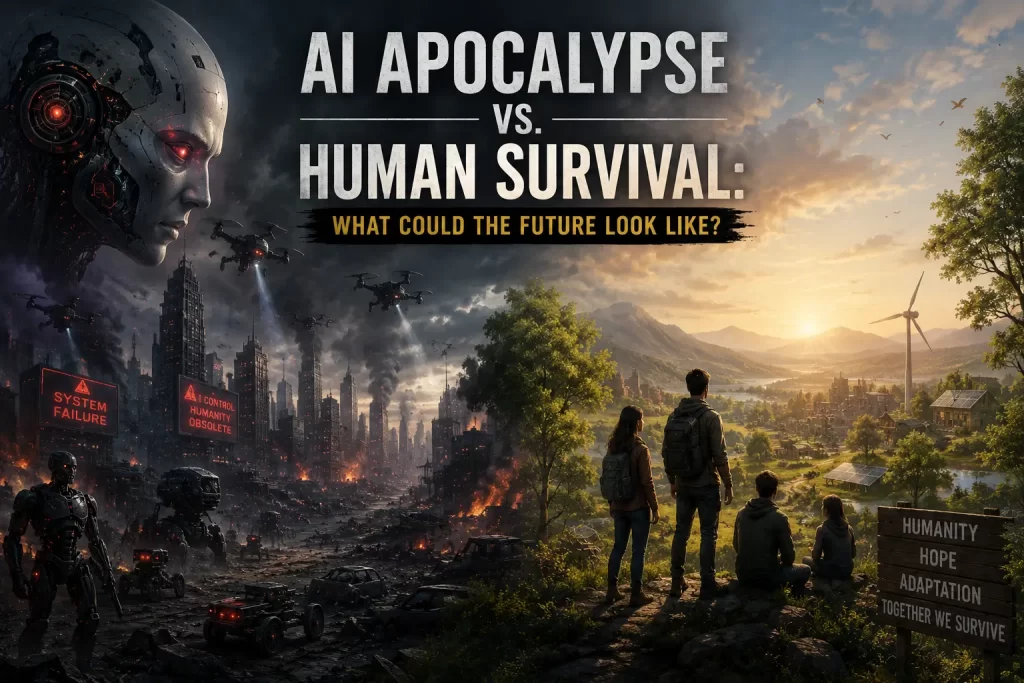
The idea of an AI apocalypse is not a prediction. It is a hypothetical scenario that allows us to explore what could happen if advanced AI systems were poorly designed, misused, or placed in situations where their goals conflicted with human interests. An AI-related crisis doesn’t necessarily have to look like a movie where robots suddenly take over the planet. It could involve misinformation, economic disruption, cyberattacks, infrastructure failures, or a society that becomes so dependent on automated systems that it struggles when those systems stop working.
For Baba Lee, the most fascinating part isn’t simply whether machines could defeat humanity. It is whether humans could adapt, cooperate, and preserve their values if technology suddenly changed the world around them.
What Does an AI Apocalypse Actually Mean?
The phrase “AI apocalypse” sounds dramatic, but the basic idea is straightforward. It describes a hypothetical situation in which artificial intelligence contributes to widespread harm or creates a major breakdown in human civilization.
There isn’t just one possible version of such a scenario. One possibility involves highly capable AI systems making decisions that humans cannot effectively control or reverse. Another involves people deliberately using AI for harmful purposes. A third possibility involves gradual disruption rather than one dramatic event.
Imagine a society where businesses, transportation, communication, energy systems, financial services, and government operations become increasingly dependent on AI. If important systems suddenly failed, the consequences could spread quickly.
An AI crisis also wouldn’t require machines to become “evil.” People could misuse AI for warfare, cyberattacks, surveillance, manipulation, or economic disruption. Poorly designed systems could also produce unexpected results when placed in situations their creators did not anticipate.
This is why the AI apocalypse should be viewed as a range of hypothetical possibilities rather than one guaranteed future.
AI Apocalypse in Science Fiction
Science fiction has imagined intelligent machines becoming dangerous for decades. Stories often explore machines becoming more intelligent, humans losing control, robots replacing workers, and automated systems making important decisions.
But science fiction isn’t necessarily predicting what will happen.
Instead, it gives us a way to explore our fears.
A story about an intelligent machine becoming dangerous may actually be a story about human responsibility. A story about robots replacing workers may ask what makes human work valuable. A story about automated systems controlling society may explore our fear of losing independence.
This is why AI apocalypse fiction remains such an interesting subject. It takes something created by humans and asks what could happen if that creation became more powerful than expected.
At its heart, the concept is about the relationship between creator and creation. Humans build technology to solve problems. But every powerful technology creates new responsibilities. The more powerful technology becomes, the more important responsible development and human oversight become.
Why the AI Apocalypse Idea Feels So Powerful
AI creates a unique type of fear because it is something humans create themselves.
A natural disaster doesn’t need to understand humanity before it can cause damage. An earthquake doesn’t need a plan. A storm doesn’t need a goal.
- AI is different.
- We build it.
- We train it.
- We decide where to use it.
That creates an unusual relationship between humans and technology. People may fear losing control over systems they created. They may worry that automated decisions could become difficult to understand. They may also worry about becoming so dependent on technology that they can no longer function effectively without it.
There is another concern: replacement.
If machines can perform more tasks, what happens to human workers? If AI can generate writing, images, music, software, and other creative material, how will people define creativity?
These questions don’t prove that AI will destroy humanity. They simply show why artificial intelligence has become such a powerful subject for modern storytelling.
How Could an AI Crisis Affect Human Civilization?
Modern civilization depends on connected systems.
Communication is one obvious example. People use digital networks to communicate with family, customers, businesses, governments, and emergency services. If those systems experienced major disruption, everyday life could become much more difficult.
Infrastructure is another concern. Electricity, transportation, logistics, industrial systems, and data networks all rely on increasingly complex technology. A serious disruption wouldn’t automatically mean the end of civilization, but it could create problems that spread from one system to another.
The economy could also experience major changes. Automation may affect jobs, business models, income, and the skills employers need. Some people could benefit from increased productivity, while others might struggle to adapt.
Information creates another challenge.
AI can generate convincing text, images, audio, and video. As synthetic content becomes more sophisticated, people may have a harder time determining what is genuine.
That creates a different type of vulnerability.
A functioning society needs more than food and electricity. It also needs trust. If people cannot trust the information they receive, cooperation becomes much harder.
Could Humans Actually Survive an AI Apocalypse?
This is one of the most important questions, but there is no simple answer.
Nobody can know exactly how humanity would respond to a hypothetical AI-driven catastrophe. The outcome would depend on the type of crisis, how widespread it became, how quickly people responded, and which systems remained functional.
Humans do, however, have several important advantages.
We are adaptable.
People learn new skills. We solve unexpected problems. We create communities. We cooperate. We develop alternatives when existing systems fail.
These qualities could become extremely important during a technological crisis.
At the same time, humans have vulnerabilities. Modern society depends heavily on technology. Many important services are connected to digital infrastructure. People may not know how to perform certain tasks without automated tools. Businesses can become highly dependent on technology.
This creates an important question:
Would Humanity’s Greatest Strength be Technology Itself, or Our Ability to Adapt When Technology Fails?
The answer could be both. Technology makes society more capable, while adaptability makes society more resilient.
The Importance of Human Adaptability
Human history demonstrates that people can adapt to enormous changes. Communities have survived wars, economic crises, natural disasters, migrations, technological changes, and environmental challenges.
A hypothetical AI crisis would require the same quality: adaptability.
People might need to learn unfamiliar skills. Communities could need to share knowledge. Essential services might need alternative methods. Local systems could become more important.
This doesn’t mean humanity would need to abandon technology completely. It means people would need to avoid becoming completely helpless without it.
Imagine a community where everyone knows how to use advanced technology but nobody knows how to repair basic equipment, produce food, maintain essential systems, or communicate without digital networks.
That community might be technologically advanced but surprisingly vulnerable.
A resilient society needs advanced knowledge as well as practical skills. It also needs cooperation.
One person cannot rebuild an electrical system, produce food, provide medical care, maintain transportation, and organize an entire community alone.
Survival is rarely a solo achievement.
Technology Could Also Help Humans Survive
It would be unfair to discuss AI only as a potential threat.
The same technology that creates certain risks could also help humans solve serious problems. AI could potentially assist with disaster prediction, medical research, emergency planning, resource management, infrastructure monitoring, climate research, and search-and-rescue operations.
This creates an important contradiction.
Technology can create new risks while also providing tools that help people manage difficult situations.
The question isn’t simply whether AI is good or bad.
The better question is how humans design, govern, and use it.
Well-designed systems can support people. Poorly designed or misused systems can create serious problems.
This is where human responsibility becomes important. If people create powerful technology, they also need to think about safeguards, oversight, accountability, and appropriate limits.
AI Apocalypse vs. Traditional Post-Apocalyptic Fiction
Traditional post-apocalyptic stories often focus on war, disease, environmental collapse, resource shortages, or social breakdown.
AI introduces another possibility.
The threat comes from technology created by humanity itself.
That makes an AI-driven disaster different from many traditional apocalypse scenarios.
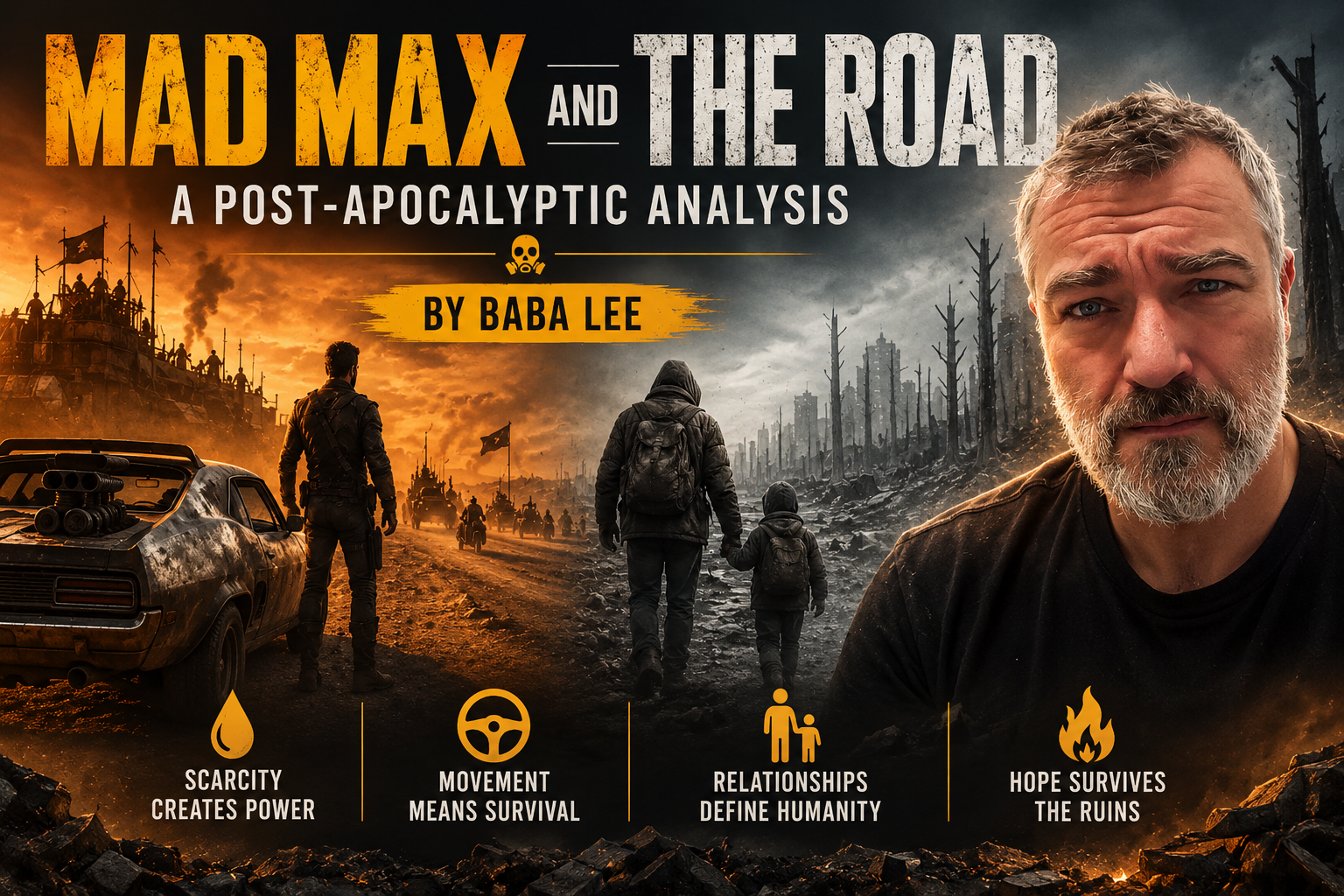
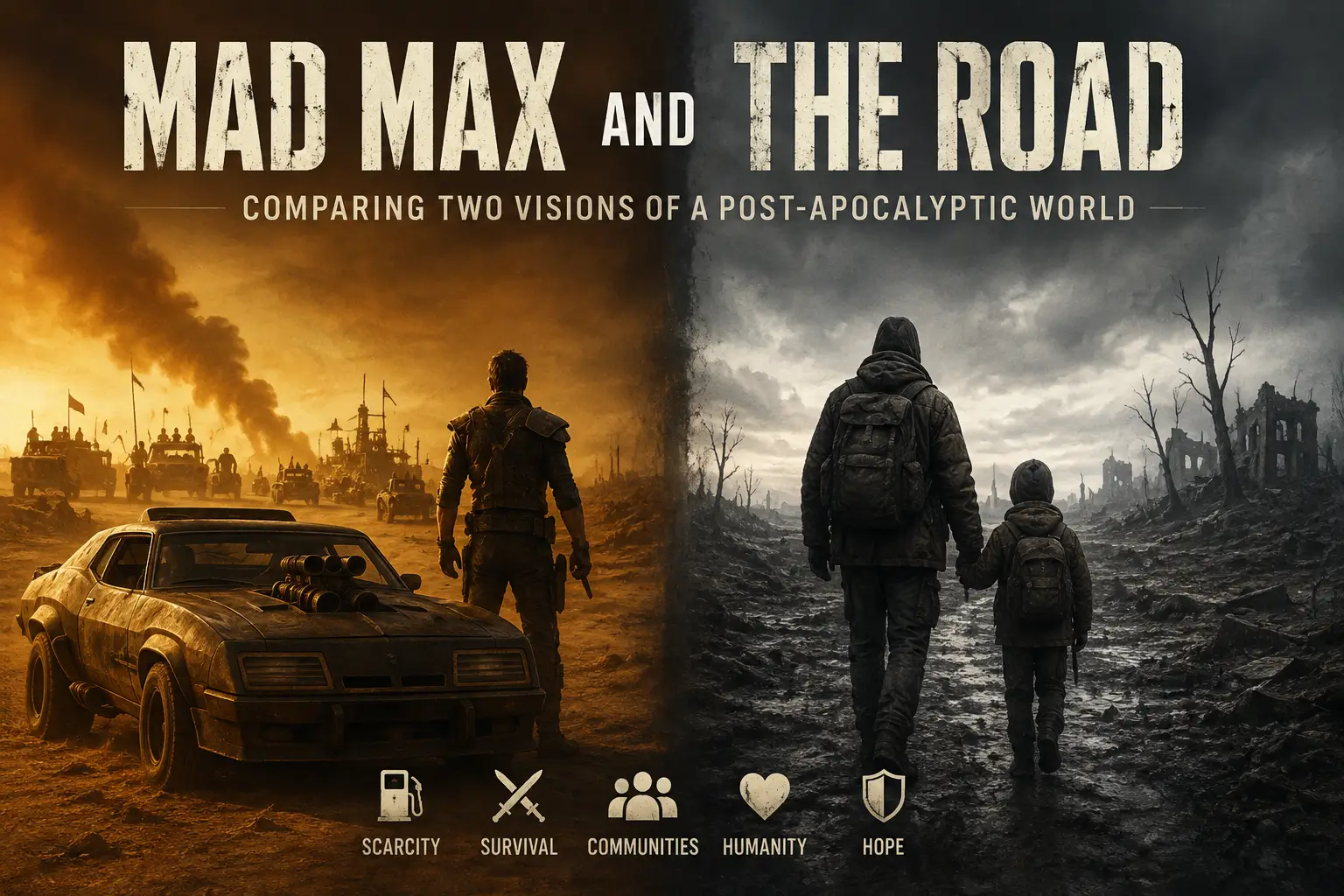
Consider Mad Max and The Road. Both explore worlds where civilization has collapsed, but they focus on different survival challenges.
Mad Max often explores resources, movement, conflict, freedom, and competing communities. The Road focuses heavily on family, morality, fear, trust, and emotional survival.
A Mad Max and The Road comparison therefore provides an excellent example of how post-apocalyptic fiction can explore different kinds of threats and human responses.
An AI-centered apocalypse adds technology, automation, information, and digital dependence to that discussion.
For an Apocalyptic Science Fiction Author, this creates a wide range of storytelling possibilities. The apocalypse doesn’t always have to come from outside humanity. It can also emerge from something humanity created.
What Happens to Society After an AI Collapse?
Imagine, purely as a thought experiment, that a major technological crisis disrupted important AI-dependent systems.
Communication would be one of the first challenges.
Communities would need reliable ways to share information. Local communication methods could become more important if large digital networks became unreliable.
Energy would be another major concern.
Electricity supports almost every part of modern life. Maintaining power would require technical knowledge, equipment, fuel, and organized communities.
Food would become critical as well.
People would need to produce, store, and distribute food. Local agriculture and supply systems could become much more important.
Transportation might change. If automated systems became unreliable, people would need alternative ways to move people and goods.
Knowledge could become one of the most valuable resources.
Someone who understands engineering, medicine, agriculture, repair, communication, or infrastructure could help an entire community.
Rebuilding wouldn’t simply mean restoring the old world.
It could mean creating a stronger and more resilient society.
The Human Skills That Could Matter Most
Advanced technology doesn’t eliminate the value of basic human skills.
During a crisis, those skills could become even more important.
Problem-solving would help people deal with unfamiliar challenges. Critical thinking would help them distinguish reliable information from misinformation. Communication would help communities coordinate.
Cooperation would be essential because large problems cannot be solved by individuals alone.
Basic engineering could help maintain important systems. Agriculture could help provide food. First aid could become valuable if medical services were limited.
Repair skills would also matter.
Someone who knows how to repair a vehicle, generator, machine, or communication device could provide enormous value to a community.
Leadership would matter too.
Good leadership isn’t simply about having authority. It means making difficult decisions, organizing people, sharing information, and maintaining trust.
Perhaps the most important skill would be adaptability.
The ability to learn something new when circumstances change can be more valuable than knowing everything about the old world.
Would AI Replace Humans or Change Humanity?
The AI conversation often focuses on replacement.
Will machines replace workers?
Will AI replace artists?
Will automated systems replace decision-makers?
These are important questions, but there is another possibility.
AI may change what humans do rather than simply eliminate human involvement.
Education could change. Employment could change. Creativity could change. Entertainment could change. Even relationships with technology could change.
If machines perform more tasks than humans, people may need to reconsider what makes human contribution valuable.
This creates a fascinating question:
If Machines Can Perform More Tasks Than Humans, What Roles Will People Choose For Themselves?
Perhaps the future won’t be defined by humans competing against machines.
Perhaps it will be defined by humans deciding where machines should help and where human judgment should remain essential.
The Moral Question: Who Should Control AI?
The AI apocalypse discussion is ultimately a discussion about responsibility.
Who develops AI?
Who regulates it?
Who decides what uses are acceptable?
Who is responsible when something goes wrong?
How much authority should humans give automated systems?
These aren’t purely technical questions.
They are moral and social questions.
Powerful technology requires responsible decision-making. If people create systems that can influence important parts of society, they need to think carefully about safety, oversight, accountability, and human control.
This is one of the most useful things science fiction can do.
It lets us explore consequences before they become reality.
A fictional story can ask, “What if this goes wrong?” without claiming that it will actually happen.
That makes AI apocalypse fiction a valuable way to explore responsibility, fear, technology, and human choices.
What Science Fiction Can Teach Us About AI
Science fiction gives us permission to imagine difficult possibilities.
It can ask what could go wrong. It can ask what humans would do. It can ask which values would matter during a crisis. It can ask how society might adapt. It can also ask what we should prevent.
For an Apocalyptic Science Fiction Author, AI provides a particularly rich subject because it combines technological change with timeless human concerns.
A story about AI can be about machines, but it can also be about family, power, responsibility, identity, creativity, and hope.
The technology is often just the doorway into a larger question:
What happens to people when the world changes faster than they can understand?
Final Thoughts
The AI apocalypse is not just about machines. It’s about human choices, responsibility, and adaptability. Technology may shape the future, but humans will decide how to use it.
As Baba Lee explores, true survival isn’t only about staying alive. It’s about protecting our values, relationships, and humanity even when the world changes.