Introduction
What happens when civilization disappears? That question has fascinated readers and movie audiences for decades. Post-apocalyptic stories remove the systems we normally depend on government, electricity, transportation, food supplies, safety, and social order and ask us to imagine what happens next.
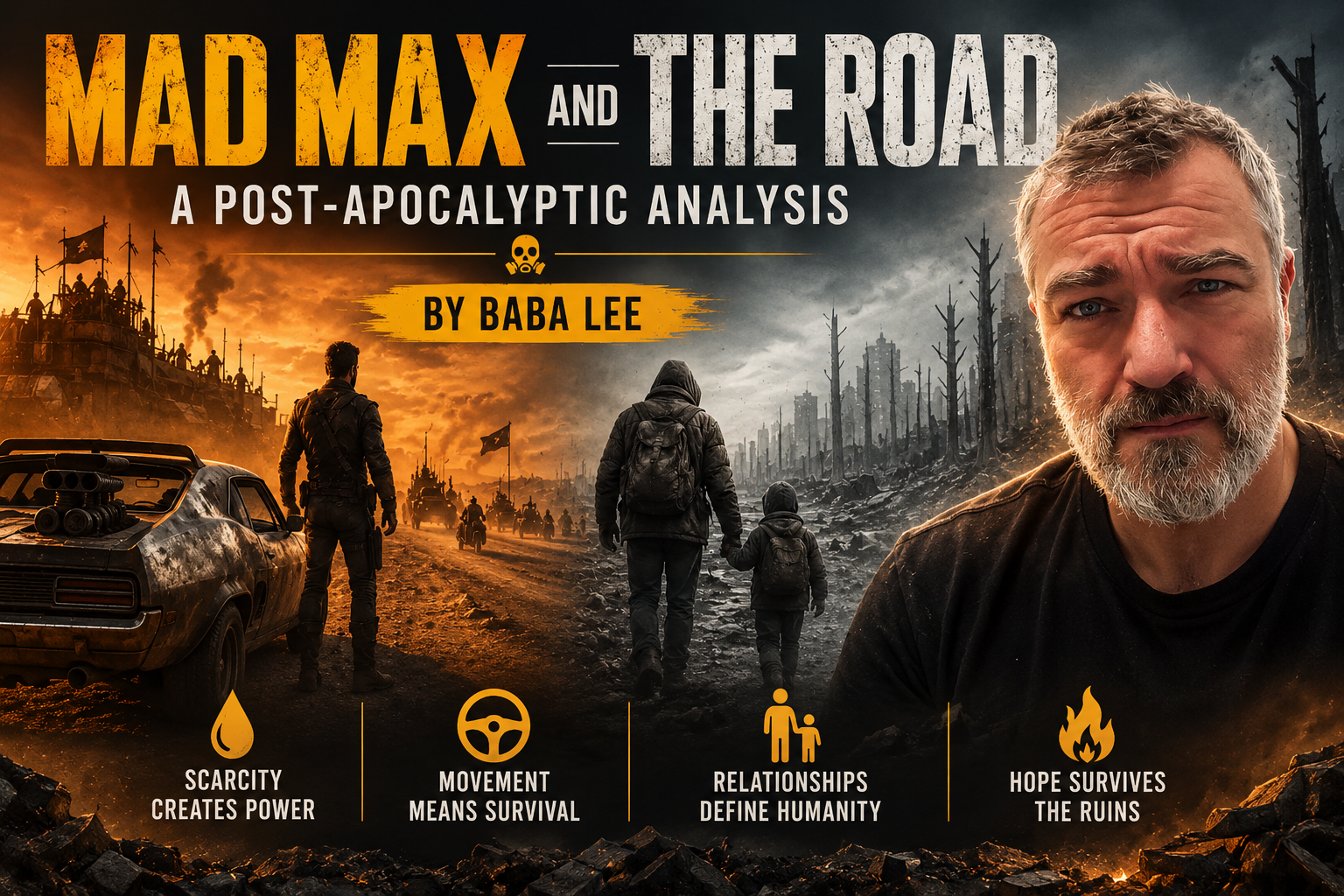
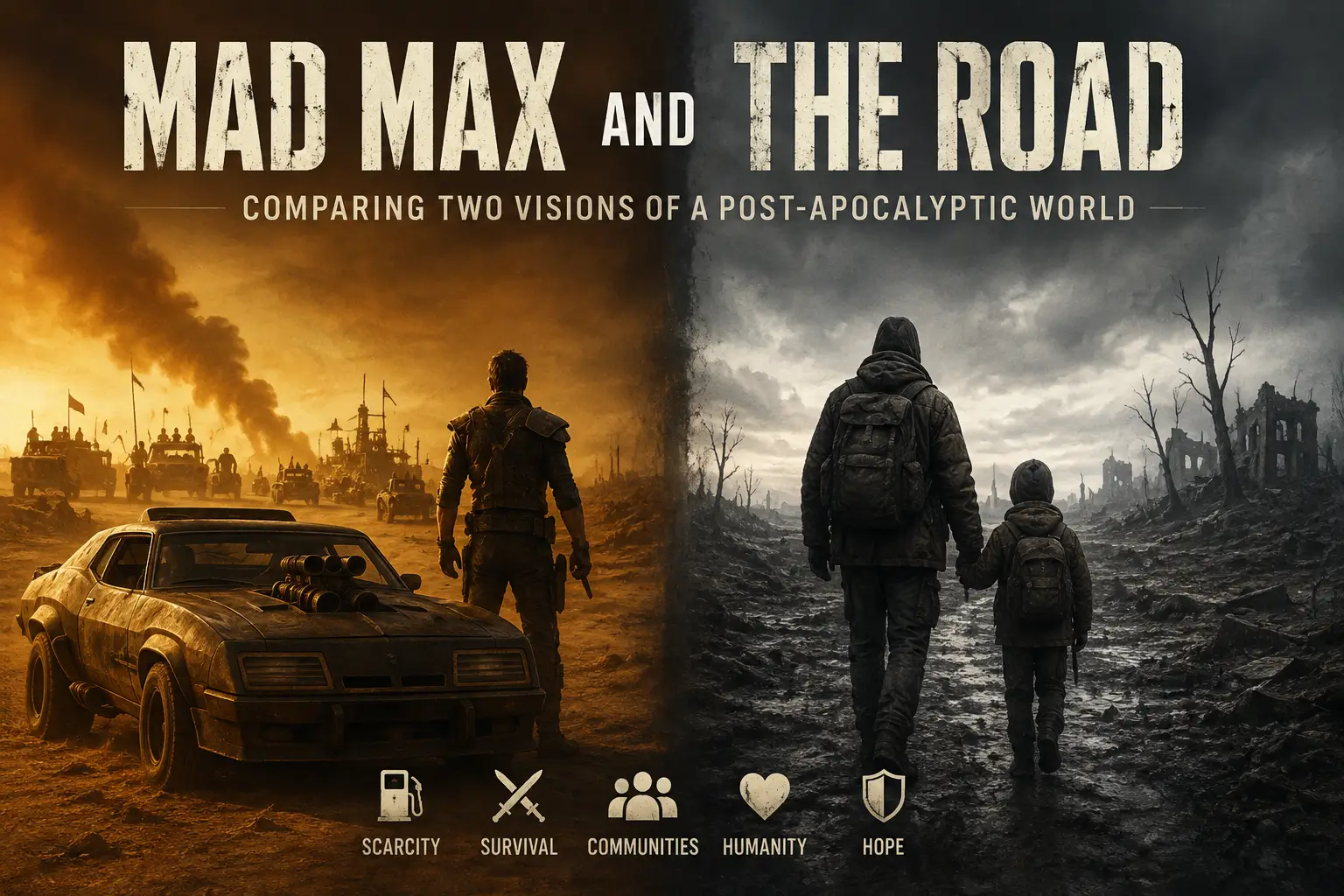
Mad Max and Cormac McCarthy’s The Road explore this idea in very different ways. Mad Max presents a harsh wasteland filled with movement, conflict, scarce resources, dangerous groups, and struggles for power. The Road takes a quieter and more personal approach. It follows a father and son traveling through a devastated world while trying to find food, shelter, safety, and a reason to continue.
A Mad Max and The Road comparison shows that post-apocalyptic fiction isn’t only about destruction. It’s also about human nature. What happens when the rules disappear? Who can we trust? What would we protect? And, most importantly, what does it mean to remain human when survival becomes difficult?
Two Different Visions of the Apocalypse
At first, Mad Max and The Road may not seem like obvious companions. One is known for action, vehicles, dramatic landscapes, and intense conflicts. The other is a literary story centered on a father and his son.
However, both explore worlds shaped by catastrophe. Resources are limited, the environment is dangerous, trust is difficult, and familiar social structures have disappeared.
The biggest difference is where each story places its attention. Mad Max often looks at survival on a larger scale. Groups compete for resources, communities rise and fall, and power belongs to those who control important supplies. The Road brings survival much closer to the individual. The relationship between a father and son becomes the emotional center of the story.
Together, these works show how different a post-apocalyptic story can feel while still exploring similar questions.
The World of Mad Max
The Mad Max universe presents a civilization that has broken down. Survivors struggle to exist in a harsh wasteland where resources have become valuable and social order has weakened.
The remains of the old world are still visible. Roads, vehicles, buildings, machines, and other technology remain, but the systems that once connected them have changed. Ordinary objects now have new meanings.
A vehicle is no longer simply transportation. It can be a means of escape, protection, or power. Fuel becomes extremely valuable. Water becomes a source of control. Territory can determine whether a community survives.
This is one of the strongest ideas in Mad Max: scarcity creates power. When people desperately need something, whoever controls it can gain influence over others.
Communities also become important. Some groups cooperate for protection and survival, while others use fear and violence to control people. The stories therefore raise an important question: does rebuilding a community automatically mean rebuilding a good society? Not necessarily. A community can provide safety while also creating new forms of inequality and control.
The World of The Road
Cormac McCarthy’s The Road approaches the same broad idea from a much more intimate perspective. The story follows a father and son as they travel through a devastated landscape with limited resources and few guarantees of safety.
They need food, shelter, warmth, and protection. But their biggest challenge is not simply staying alive. The father also wants to protect his son and help him remain a good person.
That gives the story its emotional strength.
For the father, survival is not only about avoiding death. It is about preserving something human in a world where almost everything familiar has disappeared.
For readers searching for Cormac McCarthy The Road, this is one of the most important aspects of the novel. The story uses a damaged world to explore love, responsibility, morality, fear, and human connection.
Survival and Scarcity
Scarcity connects these two stories. In normal life, many resources are easy to overlook because we expect them to be available. We turn on a tap and expect water. We visit a store and expect food. We get into a car and expect transportation to be possible.
Post-apocalyptic stories remove those assumptions.
Food becomes urgent. Water becomes essential. Shelter becomes protection. Transportation becomes a major advantage.
In Mad Max, fuel, water, vehicles, and territory can determine who has power. In The Road, food, warmth, shelter, and basic safety become part of everyday survival.
This is one reason post-apocalyptic survival stories can feel so powerful. They take ordinary needs and make them urgent. They encourage readers to imagine how human behavior might change if the things we take for granted suddenly disappeared.
Community and Isolation
Another important difference between the two works is how they approach the community.
In Mad Max, groups and communities can be essential to survival. People form alliances, defend settlements, share resources, and fight over territory. Community can provide protection, but it can also create new problems.
Leadership can become control. Resources can become tools of inequality. Cooperation can turn into conflict.
In The Road, the father and son live in a much more isolated world. They cannot automatically trust strangers, and every encounter carries uncertainty. Their relationship becomes their strongest source of emotional security.
This creates an interesting question: do humans survive better alone or together?
There is no simple answer. Isolation can reduce certain risks, but people also need cooperation if they ever hope to rebuild a functioning society.
Violence and Morality
Violence is another important theme in both works, although it is presented differently.
Mad Max often presents violence through physical action and conflicts between groups. Battles can involve vehicles, weapons, territory, resources, and freedom.
The Road approaches violence in a quieter and more personal way. Its focus on fear and trust makes violent situations feel deeply connected to questions about human behavior.
Both stories suggest that when social systems collapse, people cannot rely on the rules and institutions that once protected them.
But that creates a deeper question: can people create their own moral boundaries when society’s boundaries disappear?
This is where survival becomes more than physical. A person may remain alive while losing the values that once gave life meaning.
Family and Human Connection
Survival stories become much more powerful when characters have someone they care about.
This is especially true in The Road. The relationship between the father and son gives the story its emotional center. The father isn’t simply trying to survive. He is trying to protect his child, teach him, and help him maintain his sense of right and wrong.
That changes every decision.
A risk that might be acceptable for one person becomes much more serious when another person’s life depends on you.
Mad Max explores human connection differently. Partnerships, alliances, loyalty, and communities become important parts of survival.
Both stories remind us that people often survive for other people as much as they survive for themselves.
This idea gives post-apocalyptic survival fiction much more emotional depth. Without relationships, survival can become a simple physical challenge. With relationships, survival becomes meaningful.
Hope in a Broken World
Hope can seem difficult to imagine after civilization collapses, yet both stories contain ideas about hope.
In Mad Max, hope can be connected to freedom, resistance, escape, community, and rebuilding. Characters may continue fighting because they believe another future is possible.
In The Road, hope is more personal. It can exist through love, responsibility, and the decision to continue caring for another person even when the future looks uncertain.
This raises a powerful question: does hope require the possibility of rebuilding the world, or can hope exist simply through protecting another person?
The two works approach that question differently, but both show that survival without hope can become meaningless.
Why The Road Feels Different From Mad Max
The tone of each work creates a very different experience.
Mad Max is often fast, dramatic, visual, and action-oriented. Its wasteland is filled with movement and conflict.
The Road is slower, quieter, and more reflective. Silence becomes part of the story. The empty landscape creates a feeling of isolation, while small moments can become important because the characters have so little.
This shows that a post-apocalyptic story doesn’t need constant action to create tension. A chase can create suspense, but so can uncertainty, silence, and a difficult decision between two people.
That’s one reason post-apocalyptic survival stories can appeal to different kinds of readers. Some readers want action and adventure, while others want emotional and philosophical questions.
What These Stories Say About Civilization
Both works encourage us to think about what civilization really means.
Civilization isn’t only buildings, roads, technology, or government. It also depends on trust, cooperation, rules, responsibility, community, and shared values.
Imagine a world where every building has been destroyed, but people continue helping one another. Has civilization truly disappeared?
Or does civilization exist in the relationships between people?
This is one of the most interesting questions raised by post-apocalyptic fiction. The physical world can collapse quickly, but rebuilding trust and cooperation can take much longer.
What Mad Max and The Road Say About Human Nature
Both stories present positive and negative possibilities.
Fear can make people selfish. Scarcity can create conflict. Power can lead to abuse. Social rules can disappear.
But people can also protect their families. Communities can rebuild. Individuals can sacrifice for others. Compassion can survive.
This tension is what makes the genre so powerful.
The apocalypse becomes a test. It doesn’t simply ask whether characters can survive. It asks what kind of people they will become.
Why Readers Love Post-Apocalyptic Stories
Why are readers attracted to stories about destroyed societies and dangerous futures?
The answer isn’t necessarily that people enjoy watching the world fall apart. Often, these stories help us think about our own world.
They make ordinary things feel important. Food matters. Water matters. Family matters. Trust matters. Community matters.
They also encourage personal questions. What would I protect? Who would I trust? Would I help a stranger? What values would I refuse to abandon? What would make me keep going?
This is why post-apocalyptic survival fiction continues to attract readers. The ruined world is only the setting. The real story is often about human behavior.
An Apocalyptic Science Fiction Author can use the end of civilization to explore technology, society, and the future, while another Apocalyptic Science Fiction Author may focus on family, morality, or human relationships.
The disaster provides the setting. The author decides what the story is really about.
What Writers Can Learn From Mad Max and The Road
Writers interested in post-apocalyptic fiction can learn several important lessons from these works.
First, build a believable world. Think about food, water, transportation, communication, shelter, security, and energy. Readers will naturally wonder how people survive.
Second, give characters something meaningful to protect. Survival becomes more interesting when characters have an emotional reason to keep moving.
Third, create difficult choices. If every decision has an obvious answer, the story may lose some of its tension.
Finally, balance physical and emotional conflict. A character can be running from danger while also struggling with fear, guilt, love, or responsibility.
A strong post-apocalyptic story needs more than destruction. It needs people readers care about.
Final Thoughts
A Mad Max and The Road comparison reveals two very different visions of a world after civilization collapses.
Mad Max emphasizes movement, conflict, resources, freedom, resistance, and community. The Road focuses more closely on family, morality, fear, love, and the struggle to preserve human values.
Yet both ultimately ask a similar question:
When the world we know disappears, what remains of who we are?
That is why these stories continue to matter.
They aren’t only about the end of the world. They’re about what people do when the world they knew is gone.
They make ordinary things feel important again. Food matters. Shelter matters. Trust matters. Family matters. Community matters. Kindness matters.
The apocalypse may be fictional, but the questions it creates are deeply human.
What would you protect? Who would you trust? What values would you refuse to give up?
And if everything around you disappeared, what would you do to remain human?