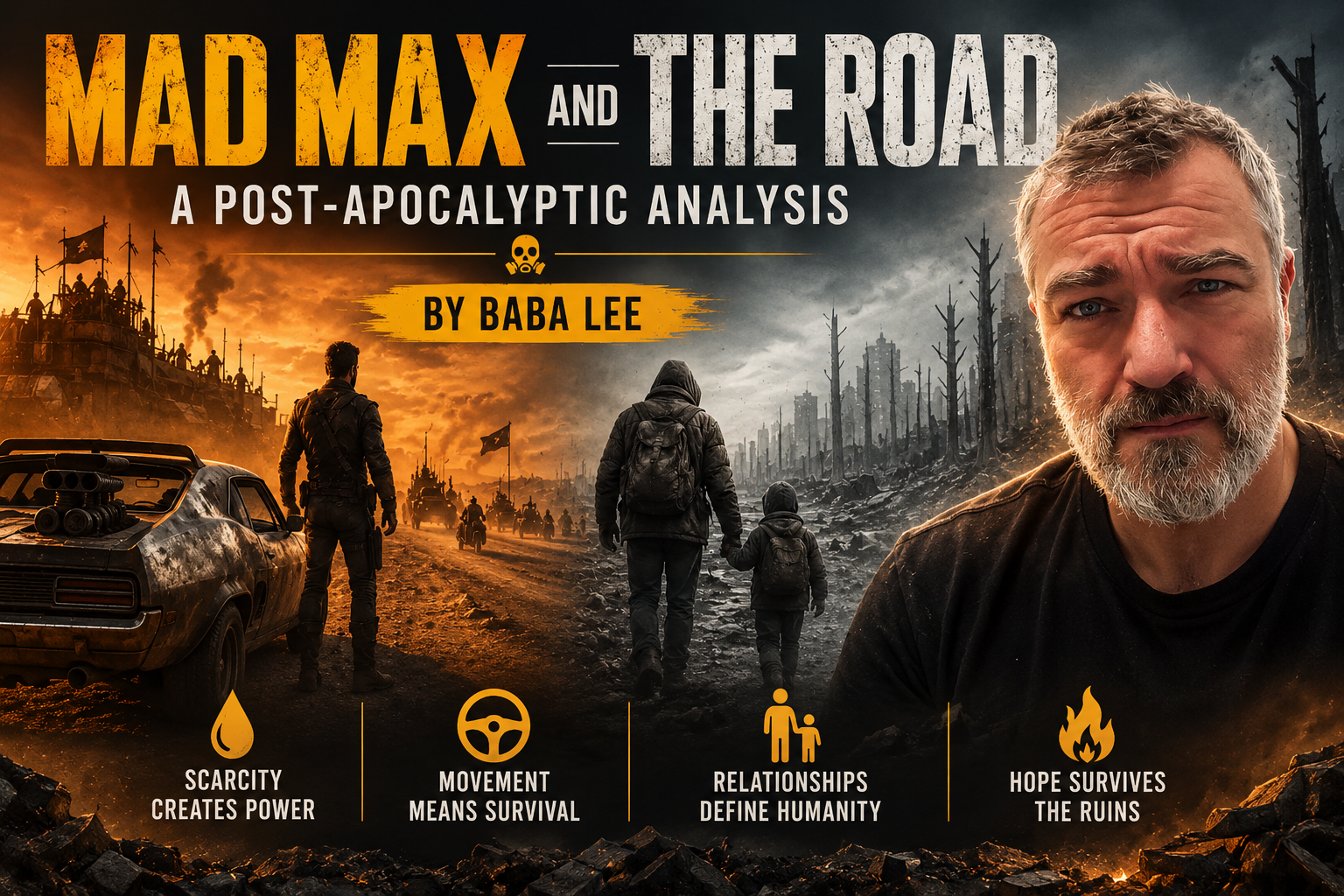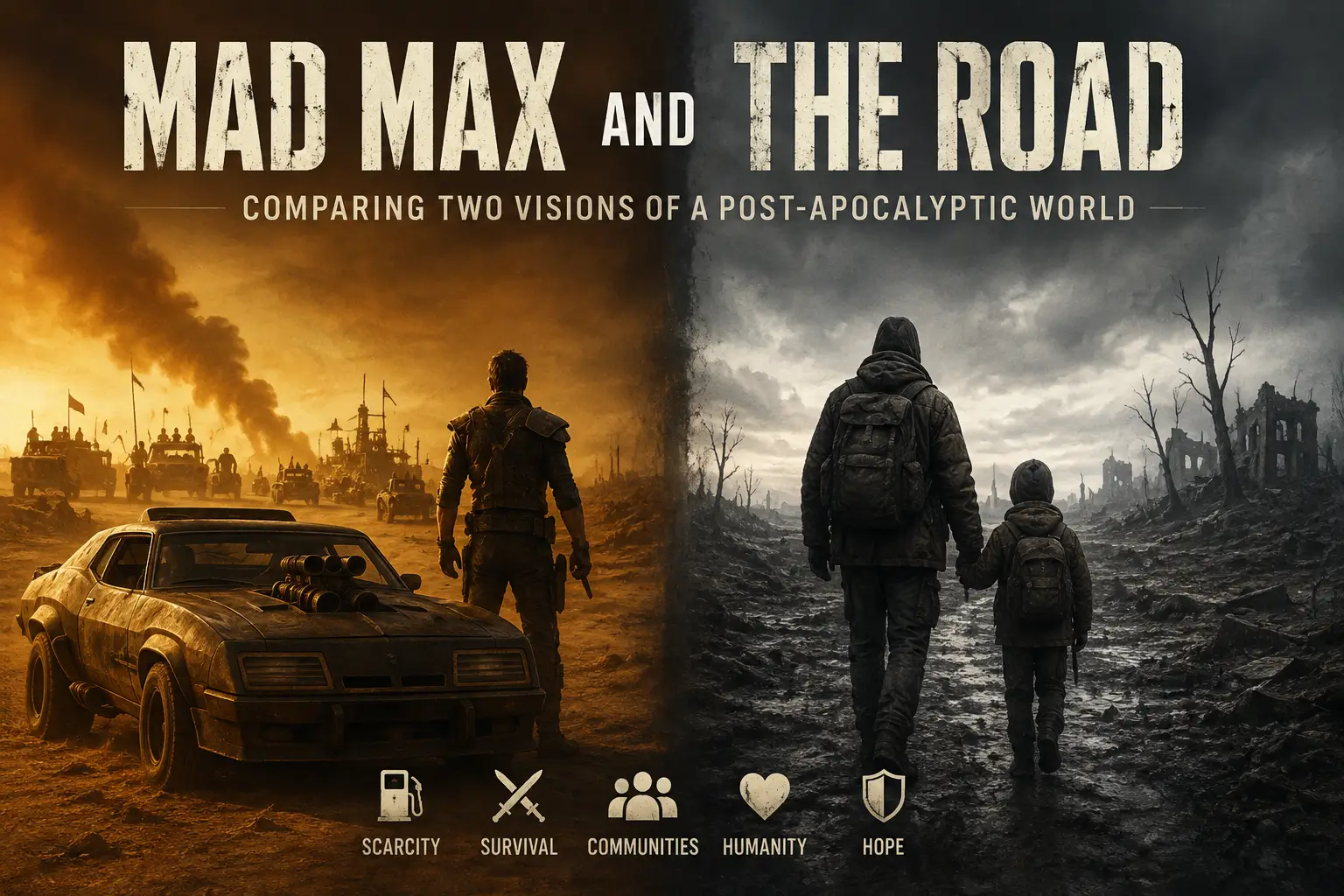
Introduction: Two Worlds After Civilization
What happens to people when the world they know no longer exists?
That question has fascinated readers and movie audiences for decades. Post-apocalyptic stories remove the systems that make modern life feel stable. Governments can disappear. Food supplies can fail. Roads can become dangerous. Communities can break apart. Technology can become difficult to maintain. Suddenly, ordinary things such as clean water, shelter, food, and human trust become matters of survival.
Mad Max and Cormac McCarthy’s The Road offer two very different answers to this question. Mad Max presents a dangerous wasteland shaped by movement, violence, scarce resources, powerful groups, and the struggle for freedom. The Road takes a quieter and more personal approach. It follows a father and son as they travel through a devastated world, searching for food, warmth, shelter, safety, and a reason to continue.
The Mad Max and The Road connection is especially interesting because both stories explore much more than the collapse of civilization. They explore what happens to people after that collapse. They ask whether morality can survive, whether strangers can still be trusted, and whether hope can exist when the future looks almost impossible.
For Baba Lee, this is one of the most interesting parts of post-apocalyptic storytelling. The ruined world is only the setting. The real story is about people and the choices they make when everything familiar disappears.
Why Mad Max and The Road Make an Interesting Comparison
A Mad Max and The Road comparison isn’t about deciding which story is better. The two works have different styles, different characters, and different ways of creating tension. Instead, comparing them helps us understand how the post-apocalyptic genre can explore the same basic fear from very different perspectives.
Both stories imagine worlds where civilization has suffered a devastating collapse. Resources are limited. The environment is dangerous. People cannot depend on the systems that once protected them. Food, water, shelter, transportation, and safety suddenly become much more important.
The biggest difference is where each story places its attention.
Mad Max often looks at survival on a larger scale. Groups compete for resources, communities develop, leaders gain power, and people fight over territory and freedom. The Road brings survival much closer to the individual. The relationship between a father and son becomes the emotional center of the story.
This creates an important question: When civilization disappears, is survival simply about staying alive, or is it also about remaining human?
That question connects both works, even though their storytelling styles are very different.
Understanding the World of Mad Max
The Mad Max universe presents a society that has broken down. Survivors live in a harsh wasteland where resources are limited and traditional systems of authority have lost much of their power.
The remains of the old world are still visible. Roads, vehicles, buildings, machines, and other technology remain, but they no longer operate within the stable society people once knew.
That changes the meaning of everyday objects.
A vehicle is no longer just a convenient way to travel. It can provide freedom, protection, or escape. Fuel becomes extremely valuable. Water becomes a source of power. Territory can determine whether a community survives.
This creates a world where scarcity shapes relationships.
People aren’t simply fighting because they are naturally violent. They are often fighting because the things they need to survive have become difficult to find or control.
Resources as Sources of Power
One of the strongest ideas in Mad Max is the connection between resources and power.
When something becomes rare, whoever controls it can gain influence over everyone who needs it.
Water is a perfect example. People cannot live without it, so controlling water can give an individual or group enormous power.
The same principle applies to fuel, food, vehicles, and territory.
This makes the wasteland more than a dangerous background. It becomes a social system built around scarcity.
People must decide whether to cooperate, compete, resist, or submit.
Survival Through Movement
Movement is also central to Mad Max.
Roads become places of escape, pursuit, discovery, and danger. Vehicles become essential tools rather than simple conveniences.
Characters may need to keep moving because remaining in one place can expose them to enemies or leave them without resources.
This gives the stories an energetic quality.
The road can represent freedom, but it can also represent danger.
That contrast is one of the reasons the Mad Max world remains so memorable.
Understanding The Road by Cormac McCarthy
Cormac McCarthy’s The Road approaches the post-apocalyptic world from a much more intimate perspective. The story follows a father and son as they travel through a devastated landscape. Their physical journey is difficult, but the challenges they face are also emotional and moral.
They need food. They need warmth. They need shelter. They need safety. They also need to decide whom they can trust. The father has another responsibility. He wants to protect his son and help him retain a sense of morality.
For readers searching for Cormac McCarthy The Road, this moral dimension is one of the most important parts of the novel. The story isn’t simply asking whether the characters can survive. It also asks what kind of people they will become while trying to survive. The relationship between the father and son gives the story its emotional center.
The Father and Son
The father isn’t simply trying to stay alive for himself. He is responsible for another human being. That changes every decision. A risk that might be acceptable for one person can become unacceptable when another person’s life depends on them. A stranger might offer help, but that same stranger could also create danger.
The father must constantly balance fear, trust, responsibility, and love.
Their journey therefore becomes both physical and emotional.
The road ahead is uncertain, but the father continues because he has someone worth protecting.
Mad Max vs. The Road: Two Forms of Survival
The biggest difference between the two works is the way they define survival.
Mad Max often presents survival through action, movement, resources, resistance, and community. The Road presents survival through family, emotional endurance, morality, and responsibility.
In Mad Max, survival is frequently connected to what characters can find, control, defend, or escape from.
In The Road, survival is connected to what the father and son can preserve within themselves.
This difference also affects the tone.
Mad Max can feel fast, energetic, dramatic, and visually intense. The Road feels quiet, bleak, intimate, and reflective.
Neither approach is more meaningful than the other. They simply highlight different parts of the human experience.
Scarcity and the Fight for Resources
Scarcity is one of the strongest connections between these stories.
In everyday life, many basic resources are easy to overlook because we expect them to be available. We expect food to be in stores. We expect water to come from a tap. We expect transportation to be available.
A post-apocalyptic world removes those assumptions.
Food becomes urgent.
Water becomes precious.
Shelter becomes essential.
Transportation can become a major advantage.
In Mad Max, fuel, water, food, and territory can determine who has power. In The Road, food, warmth, shelter, and safety become central concerns.
This is one reason post-apocalyptic survival stories can be so effective. They take ordinary needs and make them central to the story.
They also encourage readers to imagine how human behavior might change.
If two groups needed the same limited resource, would they cooperate or compete?
If helping a stranger could put your family at risk, what would you do?
These questions make the genre more than entertainment.
Community, Isolation, and Trust
Community plays a major role in Mad Max.
Survivors form groups and alliances. Communities can provide protection, resources, leadership, and belonging.
But community can also create new problems.
A powerful leader can become an oppressor. A group can use fear to control its members. Resources can create inequality.
This shows that rebuilding a community does not automatically mean rebuilding a fair society.
The Road takes a different approach by focusing heavily on isolation.
The father and son have very few people they can trust. Every encounter with another survivor creates uncertainty.
Their relationship becomes their strongest source of security.
This raises an important question:
Can humans rebuild civilization without trust?
A functioning society requires cooperation. Cooperation requires some level of trust. But trust becomes difficult when people believe every stranger could be a threat.
That tension is at the heart of many great survival stories.
Violence and the Breakdown of Social Rules
Violence appears in both works, but it serves different purposes.
In Mad Max, violence is often physical and action-driven. Characters fight over resources, territory, freedom, and control. Conflicts can become large and dramatic.
In The Road, violence is more closely connected to fear and moral uncertainty. The possibility of danger from other people creates tension even when violence isn’t happening directly.
Both works show what can happen when the systems that normally regulate human behavior disappear.
Without reliable laws or institutions, people have to decide how far they are willing to go to survive.
Violence can become a tool of control.
It can become an expression of desperation.
It can also show how far a person has moved away from the values of the old world.
This makes violence a moral issue as well as a physical one.
Morality When Civilization Disappears
If there are no functioning governments, courts, or institutions left, what determines right and wrong?
This is one of the deepest questions in post-apocalyptic fiction.
Survival can make people selfish. It can make kindness feel risky. It can force people to choose between protecting themselves and helping someone else.
Yet morality doesn’t necessarily disappear when civilization collapses.
People can still care about others.
They can still make sacrifices.
They can still choose compassion.
They can still believe that certain actions are wrong.
This is particularly important in The Road. The father wants his son to survive, but he also wants him to understand that survival does not justify every possible action.
The apocalypse therefore becomes a test of values.
It asks what people are willing to sacrifice and what they refuse to abandon.
Family, Relationships, and Human Connection
Survival becomes more meaningful when characters have someone or something worth protecting.
In The Road, the father and son relationship is central to almost everything that happens.
The father wants his son to remain safe, but he also wants him to remain compassionate. He wants to pass on values that can survive even when the old world cannot.
This makes their relationship both emotional and moral.
Mad Max explores human connection differently. Partnerships, alliances, loyalty, and communities become important forms of survival.
In both works, people often survive for someone else.
That idea gives post-apocalyptic survival stories their emotional strength.
Without relationships, survival can become a list of physical tasks.
With relationships, survival has a purpose.
Hope in a Broken World
Hope can seem difficult to find after civilization collapses, but both stories explore it.
In Mad Max, hope can be connected to freedom, resistance, escape, community, and rebuilding.
The possibility of creating something better gives people a reason to continue.
In The Road, hope is more personal.
It can exist through love.
It can exist through responsibility.
It can exist through the decision to keep caring about another person even when the future is uncertain.
This creates an important distinction.
Hope doesn’t always mean believing that everything will return to normal.
Sometimes hope means continuing to do what you believe is right even when you don’t know what tomorrow will bring.
That idea gives The Road much of its emotional power.
Two Very Different Storytelling Styles
The storytelling styles of Mad Max and The Road are dramatically different.
Mad Max often uses speed, action, visual spectacle, and large-scale conflict. Movement creates tension, while the wasteland creates a dramatic setting.
The Road uses silence, atmosphere, dialogue, memory, and emotional uncertainty. Small moments can feel important because the characters have so little.
This difference demonstrates how flexible post-apocalyptic fiction can be.
A story about the end of civilization can be loud and explosive.
It can also be quiet and deeply personal.
The setting may be similar, but the emotional experience can be completely different.
Why Post-Apocalyptic Stories Continue to Attract Readers
Readers aren’t necessarily fascinated by destruction itself.
They are often fascinated by the questions that destruction allows writers to explore.
What would you protect?
Who would you trust?
Would you help a stranger?
Could you survive without modern technology?
What values would you refuse to abandon?
Could society be rebuilt?
What makes someone human?
These questions make the genre relevant even when the stories are fictional.
An Apocalyptic Science Fiction Author can use a collapsed society to explore technology, society, survival, or the future. Another Apocalyptic Science Fiction Author can focus on family, identity, morality, or human relationships.
The disaster is the setting.
The people are the story.
What Authors Can Learn From Mad Max and The Road
Writers interested in post-apocalyptic fiction can learn several important lessons from these works.
First, build a believable world. Think about food, water, energy, transportation, communication, shelter, and security. If civilization has collapsed, readers will naturally ask how people survive.
Second, give characters something meaningful to protect. A character who simply wants to stay alive may not create the same emotional connection as someone protecting a child, family, community, or ideal.
Third, make scarcity affect the story. If food is rare, characters should behave differently because of it. If fuel is difficult to find, transportation should become important.
Fourth, create difficult choices. The strongest survival stories don’t always give characters a clear right answer. They force characters to choose between competing responsibilities.
Finally, balance physical and emotional conflict. Physical danger creates tension, but relationships and moral choices create emotional depth.
Mad Max and The Road: Where the Two Stories Meet
The Mad Max and The Road comparison ultimately reveals that both works are asking questions about survival, civilization, human nature, scarcity, violence, relationships, morality, and hope.
Their central difference is where they place their attention.
Mad Max often looks outward at the struggle between individuals, groups, and communities.
The Road looks inward at the struggle to preserve humanity within a deeply personal relationship.
Both approaches work because the apocalypse is more than a disaster.
It is a test.
It reveals what people value when comfort, security, and social order disappear.
Final Thoughts From Baba Lee
The most interesting thing about Mad Max and The Road isn’t simply that both show worlds after civilization has collapsed. It is that both ask what remains when almost everything else is gone.
Mad Max emphasizes freedom, movement, conflict, resources, resistance, and rebuilding. The Road emphasizes family, love, morality, responsibility, and hope.
Together, they show that survival isn’t only about staying alive. It is also about deciding what kind of person you want to be when the world gives you every reason to abandon your values.
For Baba Lee, that may be the most powerful idea behind post-apocalyptic storytelling.
The end of the world doesn’t necessarily have to mean the end of humanity.
As long as people can care, cooperate, sacrifice, and hope, something human can survive.
So, if everything familiar disappeared tomorrow, what would you protect first?
Your resources? Your family? Your community? Or the values that make you who you are?
Perhaps that is the real question these stories leave us with.